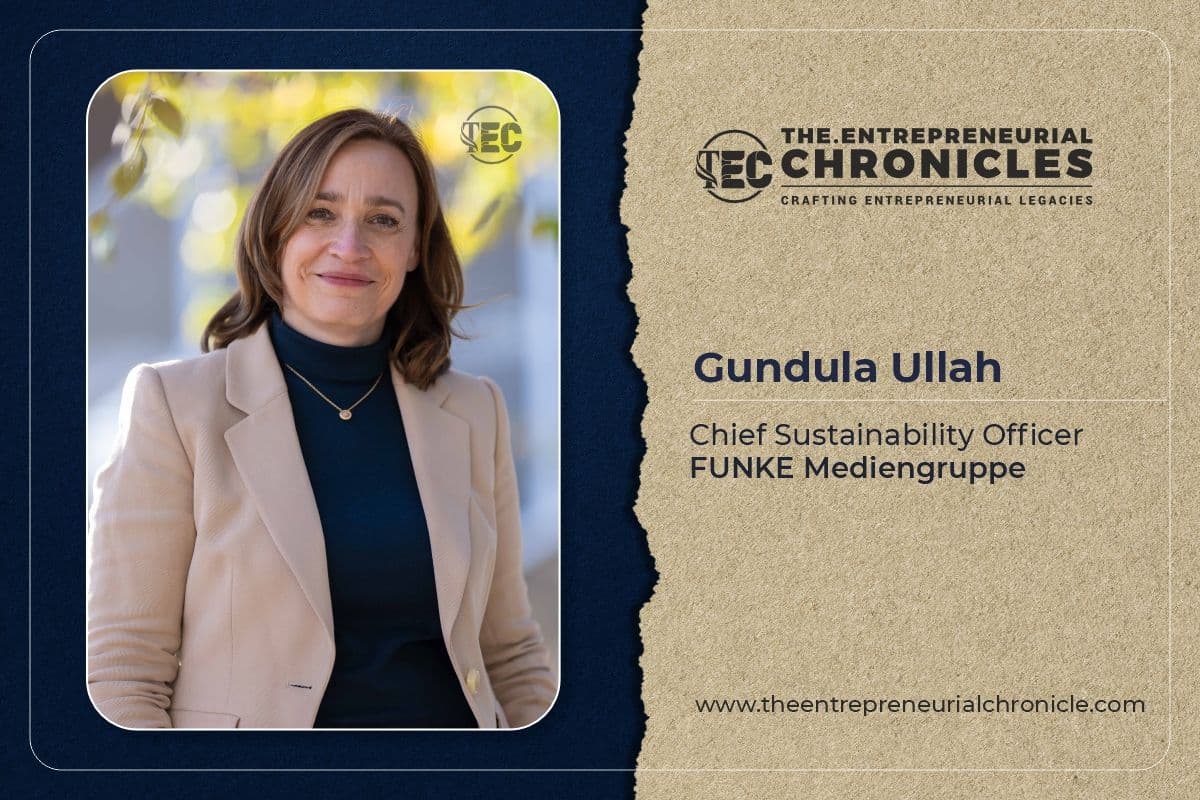
Gundula Ullah: Sustainability Doesn’t Succeed on Compliance —
It Succeeds on Commitment
Introduction:
For Gundula Ullah, sustainability is not a belief system. It is a management discipline. “Every business decision leaves a footprint — on people, on the environment, on resilience,” Gundula says. “The question is whether you understand that footprint well enough to manage it.”
As Chief Sustainability Officer at FUNKE Mediengruppe, one of Germany’s largest media companies, Gundula leads sustainability where it actually matters: in operations, procurement and value chains. Her approach is pragmatic, data-driven and deliberately unsentimental. Sustainability, in her view, only creates impact when it becomes part of how organisations allocate resources, assess risk and make trade-offs.
A Career Built on Change, Not Stability:
Gundula’s career trajectory reads less like a sectoral journey and more like a sequence of transformation phases. Aerospace, telecommunications, retail, media — each industry was already undergoing fundamental disruption when she joined it.
“What shaped me most was that none of these environments were stable,” she explains.
“Every organisation was (and still is) under immense pressure and in need of transformation.” Across industries, the patterns repeated: complex supply chains, limited transparency, rising cost pressure and a workforce searching for clarity rather than slogans. Over time, also sustainability became an opportunity to align strategy, operations and culture.
“Transformation succeeds when it is practical, measurable and deeply human,” Gundula says. “That is exactly where sustainability belongs.”
From Procurement Expertise to Sustainability Leadership:
Gundula’s transition from procurement leadership into sustainability was not a change of direction, but a logical progression. Procurement, she realised early on, is where sustainability either becomes real — or remains theoretical.
“In procurement, you see very quickly that every decision has consequences,” she says. “For emissions, for labour standards, for innovation, for resilience.”
Today, sustainability is the lens through which Gundula views the entire business. Procurement remains one of its strongest execution engines.
“Sustainability sets the ambition,” Gundula explains. “Procurement makes it real.” At FUNKE, this thinking shapes how sustainability is embedded — not as a parallel function, but as part of core decision-making.
Sustainability in a Media Company: A Dual Responsibility:
FUNKE operates at the intersection of industry and influence. On one side stands an industrial backbone: printing plants, logistics networks, energy consumption and digital infrastructure. On the other stands a media organisation with a societal mandate —safeguarding independent journalism and public trust.
Editorial responsibility remains fully independent. Gundula’s role focuses on the operational “machine room” of the company: reducing emissions, strengthening supplier standards and building resilient processes.
“Our responsibility is twofold,” she says. “Journalism protects truth. Sustainability ensures that the organisation behind it is future-ready.”
The climate targets reflect this responsibility: CO₂ neutrality across FUNKE’s media houses by 2035 and net-zero emissions across the full value chain by 2050. What distinguishes the journey is not ambition alone, but execution discipline.
From Declarations to Data-Driven Control:
FUNKE deliberately began CSRD-aligned sustainability reporting ahead of regulatory deadlines in 2023. The motivation was simple: learning by doing.
“On paper, sustainability reporting looks manageable,” Gundula notes. “In practice, data gaps, unclear responsibilities and cultural questions surface very quickly.”
Early emissions reductions taught an important lesson. Moving from spend-based emission reporting to activity-based data can create impressive year-on-year reductions. But the real work starts only when you have a sound data baseline – just like in Finance! Today, FUNKE tracks around 60 emission factors across paper, printing, energy, logistics and operations.
Building Capability at Scale: The FUNKE for Future Academy:
One challenge became clear early on: sustainability transformation often stalls because people do not know where to start. Regulatory complexity, limited resources and lack of expertise create hesitation — particularly for small and mid-sized companies. Gundula also experienced this when introducing regulatory requirements to her key suppliers.
“We presented our sustainability agenda to our key partners during a Supplier Dialogue Conference,” Gundula says. “When asked about the suppliers’ emission data, many looked at me like a rabbit caught in the headlights”.
The FUNKE for Future Academy was hence created to address exactly this gap. Initially an idea for an internal learning initiative, it quickly evolved into a platform for SMEs, designed to provide practical learning experiences to get started right away.
“The biggest barrier is not willingness,” Gundula explains. “It’s complexity.”
The Academy translates ESG regulation into practical steps, tools and templates. Its focus is capability-building rather than theory.
Value Chains as the Real Lever:
More than 95 percent of FUNKE’s emissions occur within the value chain. As a result, Gundula consistently pushes for closer integration between sustainability, procurement and supply chain management.
Procurement decisions increasingly reflect sustainability performance alongside cost and quality. Suppliers are engaged early, expectations are transparent and collaboration replace spurely transactional relationships.
“Sustainability does not happen in isolation,” she says. “It happens where companies and partners make decisions together.”
Leadership at Scale: Navigating Crisis and Continuity:
As former Chairwoman of BME Germany, the German Association of
Procurement and Logistics, Gundula represented over 10,000 companies whose combined spend represents about 30% of German GDP. Her tenure coincided with unprecedented disruption: pandemic shocks, energy volatility, geopolitical instability, and accelerated digitalization through the rise of Artificial Intelligence.
These experiences reinforced a critical insight: procurement and sustainability are not cost centers. They are stabilizers. Transparency builds trust. Resilience protects continuity. Sustainability safeguards competitiveness.
Her ongoing work with the World Printers Forum of WAN-IFRA, the World Association of New Publishers, extends this thinking globally, supporting publishers as they navigate through transformation from print to digital, with focus on cost pressures, and technological change and decarbonisation.
Leadership, Bias, and Belonging:
Operating in traditionally male-dominated environments has shaped Gundula’s leadership style. She speaks openly about being underestimated — and about using scepticism as a source of momentum rather than resistance.
“At some point, you stop taking it personally,” she says. “You start using it strategically.” Her leadership approach is grounded and consistent. Authority is earned through clarity and delivery, not volume.
“Transformation rarely happens because the system is ready,” Gundula notes. “It happens because someone shows up and does the work anyway.”
Sustainability as a Direction, Not a Department:
While accolades such as the German Sustainability Award and the World Printers Summit “Going Green” Award recognize her contributions, Gundula measures success differently:
“For FUNKE, the legacy is simple: that we remain a place where truth matters, where journalism is protected, and where decisions are made with the next generation in mind. If our sustainability work helps secure that long-term relevance — operationally and culturally— then it has done its job.
For the next generation of procurement and sustainability leaders, I hope the legacy is courage. Courage to start before everything is perfect. Courage to push through resistance. Courage to speak up when something is wrong. They will need it — because transformation rarely happens when the system is ready. It happens when someone is willing to lead.
If anything, I want my work to show that sustainability is not a department — it’s a direction. And that real impact comes from consistency, clarity and the belief that the future is worth shaping.”
Gundula Ullah : The Most Visionary Leaders in Sustainability & Climate Action to Watch in 2026
Leave A Reply
Your email address will not be published.*