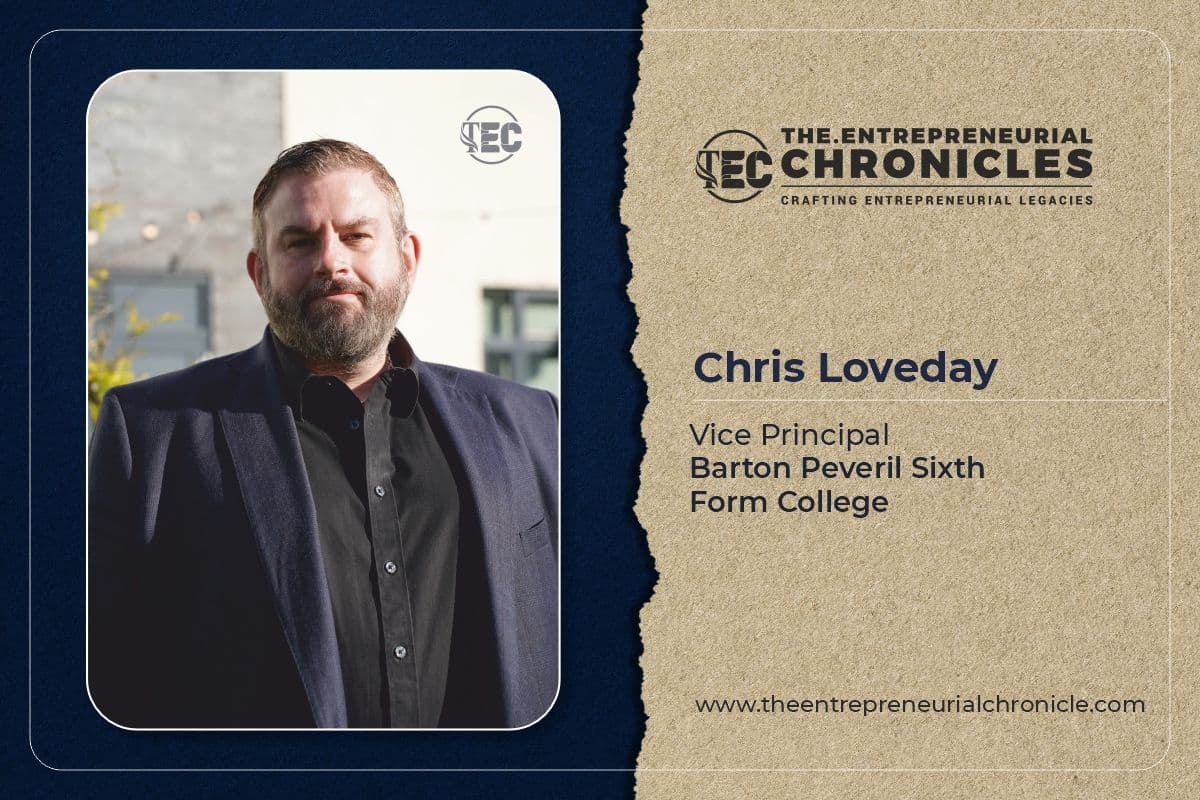
Architect of Digital Equity and the Quiet Revolution of AI in Education
In an era where artificial intelligence is reshaping every industry at extraordinary speed, some of the most meaningful transformations are being led not by technologists or Silicon Valley founders, but by educators who understand both systems and souls. At the forefront of one such transformation stands Chris Loveday, Vice Principal (Business Services) at Barton Peveril Sixth Form College, an institution now nationally recognised for its pioneering work in artificial intelligence, digital equity, and operational resilience.
Chris’s leadership journey is defined not by convention, but by resilience, lived experience, and an unwavering belief that technology must always serve people. His work today is shaping a future where education evolves ethically, inclusively, and intelligently.
An Unconventional Path to Senior Leadership:
Chris Loveday did not arrive at senior leadership through a traditional academic route. His career began at the most operational level of the education ecosystem as a leisure assistant working in a school gym. Without formal qualifications in his early years, he learned education from the ground up, experiencing firsthand how frontline roles sustain institutions.
This formative experience became one of his greatest leadership advantages. As he progressed into management and later senior leadership roles, Chris carried with him an intimate understanding of how decisions affect staff at every layer. Long before he formally taught, he was observing teaching practices as a senior leader driving him to pursue his degree, teaching qualifications, and later adult education to deepen his grasp of pedagogy.
Rather than viewing his unconventional entry as a limitation, Chris transformed it into his foundation. His leadership today is grounded in humility, continuous learning, and the belief that credibility is built through lived accountability, not titles alone.
A Human-Centred Philosophy of Leadership:
At the heart of Chris Loveday’s leadership is a simple yet powerful principle:
Inspire, support, motivate, and challenge.
For Chris, leadership is not about hierarchy or control it is about service. Operational excellence, in his view, only exists when processes function smoothly and when the people within those systems are respected, protected, and empowered.
He defines effective operations as:
- Eliminating friction from workflows
- Ensuring every task has visible value
- Protecting staff time and wellbeing
- Designing systems that serve people—not dominate them
His leadership style is deeply open and visible. He leads from the front, owns mistakes publicly, and views failure as a necessary companion to progress. Most importantly, he believes transformation only works when leaders take people with them, not ahead of them.
This human-centred philosophy would later become the cultural backbone of Barton Peveril’s AI transformation.
The Strategic Awakening: When AI Entered the Equation
The catalytic moment for Barton Peveril’s artificial intelligence journey arrived in early 2024 just three months after Chris stepped into his Vice Principal role. A senior leadership meeting was convened with one defining focus: the future of AI in education.
At that time, Chris openly acknowledged that he was not an AI specialist. What he did possess, however, was deep expertise in project management, systems thinking, and institutional change. Supported by a Principal who gave him the rare permission to fail safely, Chris embarked on what would become one of the most ambitious AI adoption programmes within UK further education.
Rather than deploying AI directly into classrooms, the leadership team made a bold strategic decision: AI would first transform business services. The objective was to reduce administrative burdens, eliminate human error in high-risk processes, and free staff to focus on student-centred work.
This careful sequencing proved to be a defining success.
Designing Bespoke AI for Real-World Impact
Under Chris’s direction, Barton Peveril developed a suite of bespoke AI agents tailored to real operational needs, including:
- Enrolment and admissions processing
- Examination certification checks
- Timetabling optimisation
- Student analytics and engagement monitoring
Each tool followed one unwavering design principle:
AI must enhance the human role, never replace it.
Rather than imposing solutions from the top down, staff across departments were invited to co-design systems. Teams mapped workflows, identified pain points, and shaped how each digital agent would function. This inclusive approach built trust, improved solution quality, and created strong cultural ownership.
Chris often notes that the most difficult challenge was not technological it was decisional. Choosing the right problems to solve with AI prevented the institution from adopting technology for technology’s sake.
Ethics, Safeguarding, and Governance Without a Rulebook
Barton Peveril’s AI programme began before formal UK or EU regulatory frameworks for AI in education were established. With no national playbook to follow, ethical responsibility rested squarely on institutional leadership.
Under Chris’s direction, every AI deployment underwent:
- Full GDPR compliance testing
- Secure development within the college’s controlled digital tenancy
- Extensive red-team testing in non-live environments
- Senior leadership safeguarding and ethical review
At every stage, one guiding question remained central:
“Just because we can, should we?”
This values-first governance model would later become a major factor behind Barton Peveril’s national credibility in responsible AI adoption.
Barton Buddy and the Psychology of Trust
One of the most ambitious initiatives was the launch of Barton Buddy, a student-facing digital assistant developed to support academic and administrative queries. Technically robust from day one, the system nevertheless encountered a human challenge: adoption was initially slow.
Students expected open-internet access comparable to consumer AI platforms. When they discovered Barton Buddy operated within safeguarded boundaries, early trust wavered. Rather than enforce usage, Chris made a counterintuitive decision to step back.
With reduced pressure and easier voluntary access, engagement rose organically, particularly during evenings and weekends. Today, Barton Buddy is widely used, though not universally—a balance Chris views as healthy and authentic.
Empowering the Workforce Through AI Enablement
From the outset, Chris was unequivocal: AI at Barton Peveril would never be positioned as a job-reduction tool. Instead, it would be framed as a capacity-creator.
This philosophy shaped the institution’s approach to professional development:
- Whole-staff AI training days
- Voluntary CPD sessions
- Open access to AI tools
- Protected experimentation time
The cultural response exceeded expectations. Staff began attending non-mandatory training in their own free periods, clear evidence of trust, curiosity, and psychological safety. Barton Peveril cultivated something rare: innovation without fear.
National Influence and Policy Leadership:
Chris’s work soon reached national prominence. He became a member of the AI in Education Strategic Committee and a contributor to the Department for Education Advisory Board, where he now helps shape the future of AI governance in UK education.
His policy advocacy consistently centres on three pillars:
- Safeguarding and student data protection
- Digital equity and access
- Clear national accountability frameworks
In his view, without strong alignment, AI adoption risks deepening inequality rather than solving it.
Author, Speaker, and Translator of Complexity
Chris is the author of Leading the Shift: Enhancing Operational Efficiency With AI, a practical leadership guide grounded in real institutional experience. Written in clear, accessible language, the book serves as a roadmap for non-technical leaders navigating digital transformation.
He is also a sought-after speaker at national platforms including BETT UK, where he is respected for demystifying AI and confronting misconceptions around data governance and intellectual property.
Chris intentionally avoids positioning himself as a technical expert. Instead, he serves as a translator of complexity bridging innovation with institutional reality.
Cybersecurity, Cloud Migration, and Digital Resilience
Under Chris’s strategic leadership, Barton Peveril transitioned fully to the Google Cloud Platform, dramatically strengthening its cybersecurity, data resilience, and disaster-recovery capabilities.
The migration required careful risk governance:
-Secure data transfers
- Zero-downtime service continuity
- Complex system integration
- Human change-management support
The outcome is a future-proof digital infrastructure that underpins AI, analytics, automation, and secure collaboration at scale.
Digital Equity as a Moral Imperative:
Perhaps the most values-driven dimension of Chris’s leadership is his commitment to digital equity. At Barton Peveril, equity is not aspirational it is operational.
Through a fully sponsored digital equity strategy supported by ASUS and Academia, every student today is guaranteed:
- Access to a suitable learning device
- Reliable internet connectivity
- A safeguarded institution-built language model
- Ongoing digital-skills development
For Chris, digital equity extends beyond hardware. It encompasses confidence, safety, and the ability to participate fully in an AI-driven future without disadvantage.
Sustainability and Environmental Responsibility in AI
Chris is deeply conscious of the environmental cost of digital transformation. Barton Peveril’s ambition to become carbon-neutral by 2030 actively shapes how technology is deployed.
Cloud migration has reduced on-site energy use. Smaller AI models are prioritised over energy-intensive general systems. Digital waste is continuously managed. Every innovation is assessed not just for efficiency but for environmental impact.
For Chris, progress without conscience is not progress at all.
The Next Frontier: AI-Powered Assessment
One of the most promising projects currently underway is an AI-powered marking and feedback system aligned directly to Barton Peveril’s curriculum. Its objectives include:
- Reducing teacher workload
- Accelerating formative feedback
- Preserving human assessment integrity
- Enhancing personalised learning pathways
This represents Chris’s vision of balanced AI integration where machines handle the mechanical, and educators remain custodians of meaning.
Legacy, Impact, and the Quiet Power of Change
When asked about legacy, Chris avoids grand narratives. His metric of success is deeply human:
- Has the student experience improved?
- Have staff pressures eased?
- Has one more leader been empowered to act ethically?
If the answer is yes, he considers the work meaningful.
His message to emerging education leaders is urgent and clear:
“There will never be a perfect time. If you have the passion, the resources, and the support—now is the time to act. Use technology to serve people, not the other way around.”
Closing Perspective:
In a world accelerating toward automation, Chris Loveday stands as proof that the future of education will not be defined by algorithms alone but by the ethics, courage, and humanity of the leaders who deploy them. His influence continues to ripple across digital systems, national policy, and most importantly, through the lives of thousands of students whose futures are being shaped by an education ecosystem that dared to evolve with integrity.
Leave A Reply
Your email address will not be published.*